Bold ideas sparked change when frustrated French filmmakers in the late 1950s challenged every rule they inherited. This rebellion against stale European studio productions gave birth to New Wave cinema, a movement that prioritised authenticity, personal vision, and a fresh approach to storytelling. Understanding its origins lets you trace how handheld cameras, fragmented narratives, and urban realism inspired global filmmaking techniques that still drive contemporary stories and style today.
Table of Contents
- Defining New Wave Cinema and Its Origins
- Global Movements and Key Innovators
- Core Techniques and Narrative Innovations
- Ongoing Legacy in Contemporary Filmmaking
- Misconceptions and Common Challenges
Key Takeaways
| Point | Details |
|---|---|
| Emergence of New Wave | New Wave cinema challenged conventional narratives and visual styles, promoting authenticity through a radical departure from established norms. |
| Global Influence | The movement inspired similar trends worldwide, driven by young filmmakers’ access to technology and a desire for personal storytelling. |
| Technical Innovations | Techniques like handheld camera work and non-linear editing enhanced realism and intimacy in storytelling, influencing modern filmmaking. |
| Enduring Legacy | The principles of New Wave continue to shape contemporary cinema, emphasising auteurism, location authenticity, and narrative experimentation. |
Defining New Wave Cinema and Its Origins
New Wave cinema emerged in the late 1950s as a radical departure from conventional filmmaking. This movement fundamentally shifted how stories were told on screen, challenging every established rule about narrative structure and visual style.
The term Nouvelle Vague (New Wave) originated in France, where a group of ambitious young filmmakers grew frustrated with the stagnant state of their national cinema. They rejected the polished studio productions that dominated European screens, viewing them as creatively exhausted and disconnected from reality.
These filmmakers didn’t want to work within the system—they wanted to dismantle it. Their dissatisfaction became the fuel that powered an entirely new cinematic language.
The French Foundation
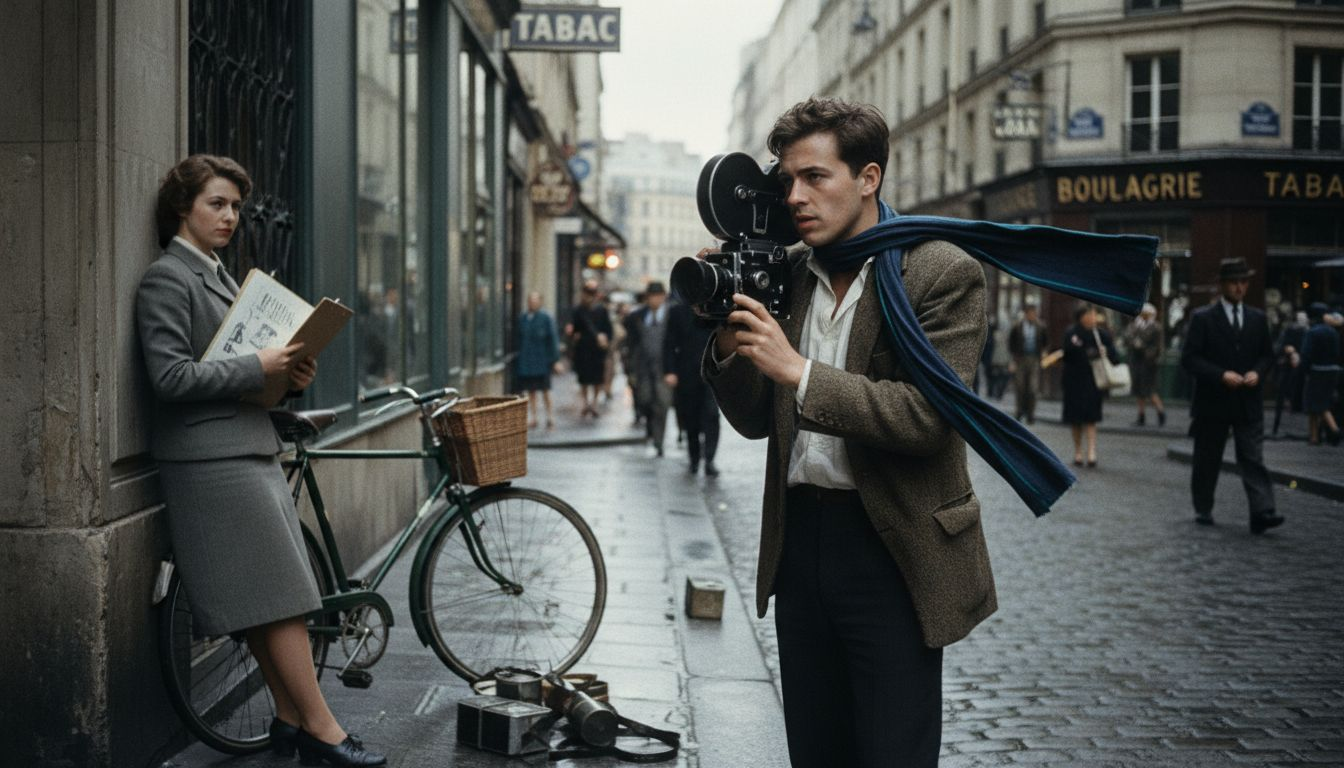
The French Nouvelle Vague introduced vibrant realism and naturalistic performances that felt authentic rather than staged. Directors like François Truffaut and Jean-Luc Godard rejected elaborate set designs and instead filmed on actual streets, in real apartments, and in genuine Parisian locations.
Key innovations that defined their approach:
- Handheld camera work that created an intimate, documentary-like quality
- Jump cuts and non-linear editing that disrupted traditional storytelling
- Ambiguous endings that refused neat narrative resolution
- On-location shooting instead of controlled studio environments
- Contemporary social issues woven directly into personal narratives
- Improvised dialogue that sounded like an actual conversation
These weren’t technical experiments for their own sake. Each choice served a deeper purpose: authenticity. The filmmakers wanted audiences to feel the texture of modern life, not escape into fantasy.
Understanding the Broader Movement
The New Wave wasn’t confined to France. Youth, cities, and the construction of a global market became catalysts for cinematic new waves spreading across the world. As film education globalised and young filmmakers gained access to affordable equipment, similar movements emerged in Taiwan, China, and beyond.
What connected these diverse movements wasn’t a rulebook—it was a shared rejection of tired conventions and a commitment to personal artistic vision.
New Wave cinema placed mise en scène (the visual arrangement within each frame) at the heart of storytelling, prioritising what you see over how the story is edited together.
The Practical Foundation for Today’s Filmmakers
Understanding the New Wave matters because its DNA runs through contemporary cinema. Every indie film shot on a DSLR, every streaming series that abandons the three-act structure, every dialogue-heavy drama filmed in real locations—these descend directly from what Truffaut, Godard, and their peers pioneered.
The movement proved that you didn’t need massive budgets or studio backing to make important cinema. A camera, genuine locations, and a clear artistic vision could be enough.
Pro tip: Study how New Wave directors used mise en scène to tell stories visually—watch how they compose frames to reveal character and emotion without exposition. This translates directly to how you’ll plan your own shot compositions.
Global Movements and Key Innovators
The New Wave wasn’t a purely French phenomenon. Once the movement gained momentum in Paris, filmmakers across Asia, Japan, South Korea, and Hong Kong recognised something vital: cinema could be remade on their own terms.
Each region developed its own distinct flavour, shaped by local economics, politics, and culture. Yet they all shared that core New Wave spirit—rejecting commercial formulas and prioritising artistic integrity.
East Asian Renaissance
Economic booms and globalisation shaped Taiwan’s and China’s new waves profoundly. As these nations modernised rapidly, filmmakers captured the tension between tradition and change. They filmed bustling urban streets, fractured families, and characters caught between worlds.
Taiwan’s cinema flourished during the 1980s and 1990s. Directors like Hou Hsiao-hsien and Edward Yang created slow-paced, visually stunning films that prioritised observation over plot. Their work proved that commercial success and artistic ambition weren’t opposites.
China’s Fifth Generation filmmakers emerged after the Cultural Revolution, bringing fresh perspectives to a newly reopened industry. Directors including Zhang Yimou and Chen Kaige blended international film language with distinctly Chinese storytelling.
Regional Variations Across Asia
New Wave movements across France, Japan, South Korea, and Hong Kong demonstrate how filmmakers adapted the movement’s core principles to their specific contexts. What worked in Paris required reinvention elsewhere.
Key regional characteristics:
- Japan: Blended New Wave aesthetics with traditional aesthetics and philosophical depth
- South Korea: Combined formal experimentation with rapid social commentary
- Hong Kong: Created a distinctive style mixing art cinema with popular genre elements
- Taiwan: Emphasised long takes and naturalistic performances in urban settings
These weren’t pale imitations of French cinema. Each movement possessed genuine originality.
To illustrate the distinctive qualities among regional New Wave movements, consider the following comparison:
| Region | Distinctive Focus | Influential Directors | Societal Context |
|---|---|---|---|
| France | Urban realism, auteur vision | Truffaut, Godard | Postwar cultural upheaval |
| Japan | Philosophical themes, fusion | Ōshima, Imamura | Rapid postwar modernisation |
| Taiwan | Urban alienation, long takes | Hou Hsiao-hsien, Yang | Urbanisation, identity shifts |
| China | Visual symbolism, history | Zhang Yimou, Chen Kaige | Post-Cultural Revolution era |
| South Korea | Social critique, experimentation | Park Kwang-su, Jang Sun-woo | Democratisation, societal flux |
| Hong Kong | Genre blending, pop culture | Wong Kar-wai, Tsui Hark | Economic boom, globalisation |
The Common Thread
Despite regional differences, certain patterns connected all these movements:
- Young filmmakers challenging established industry practices
- Economic expansion enabling new production methods
- Urban modernisation providing visual and thematic material
- Personal vision prioritised over commercial formula
- Innovative narrative structures reflecting contemporary reality
They proved the New Wave was fundamentally about approach, not geography.
Global new waves demonstrated that cinema could be simultaneously artistic and commercially viable, dissolving the false choice between integrity and audience appeal.
What This Means for Your Work
Studying these global movements reveals something crucial: filmmakers worldwide faced similar creative impulses at similar moments. This suggests the drive to reinvent cinema emerges from identifiable conditions—modernisation, youth, access to technology, and cultural transition.
Recognising these patterns helps you understand your own moment in cinema history.
Pro tip: Watch films from multiple regional new waves—not just French ones. Analyse how directors in Taiwan or South Korea solved similar storytelling problems differently, then consider which approaches might suit your own creative vision and context.
Core Techniques and Narrative Innovations
New Wave filmmakers didn’t just tell different stories—they invented entirely new ways to tell them. Every technical choice, from camera movement to editing rhythm, served a single purpose: authenticity and immediacy.
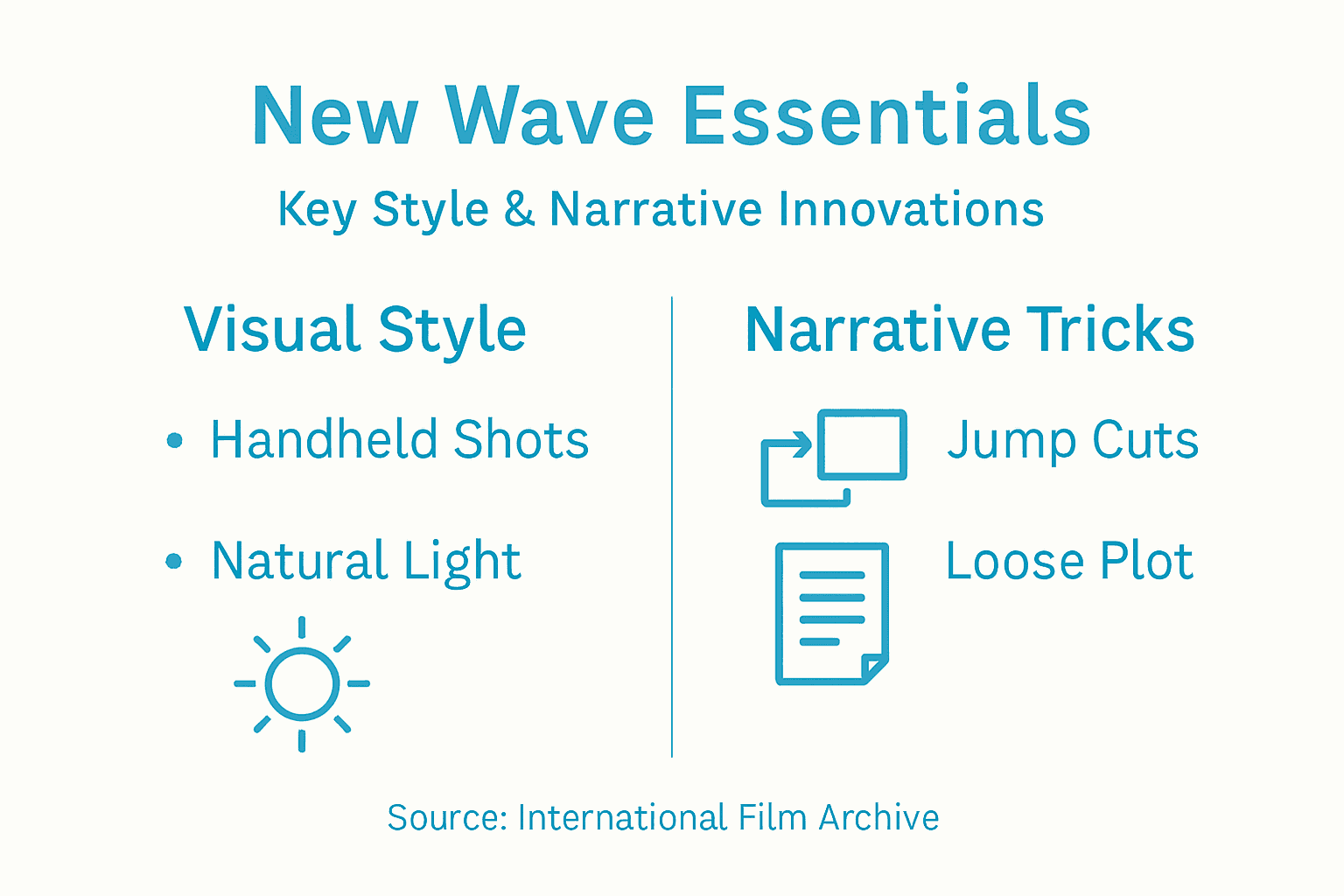
These weren’t experimental gimmicks. They were deliberate tools designed to capture truth in ways traditional cinema could not.
Visual and Technical Innovations
Handheld cameras, natural lighting, and on-location shooting became hallmarks of New Wave visual language. These techniques lent immediacy and realism that studio lighting and controlled sets could never achieve.
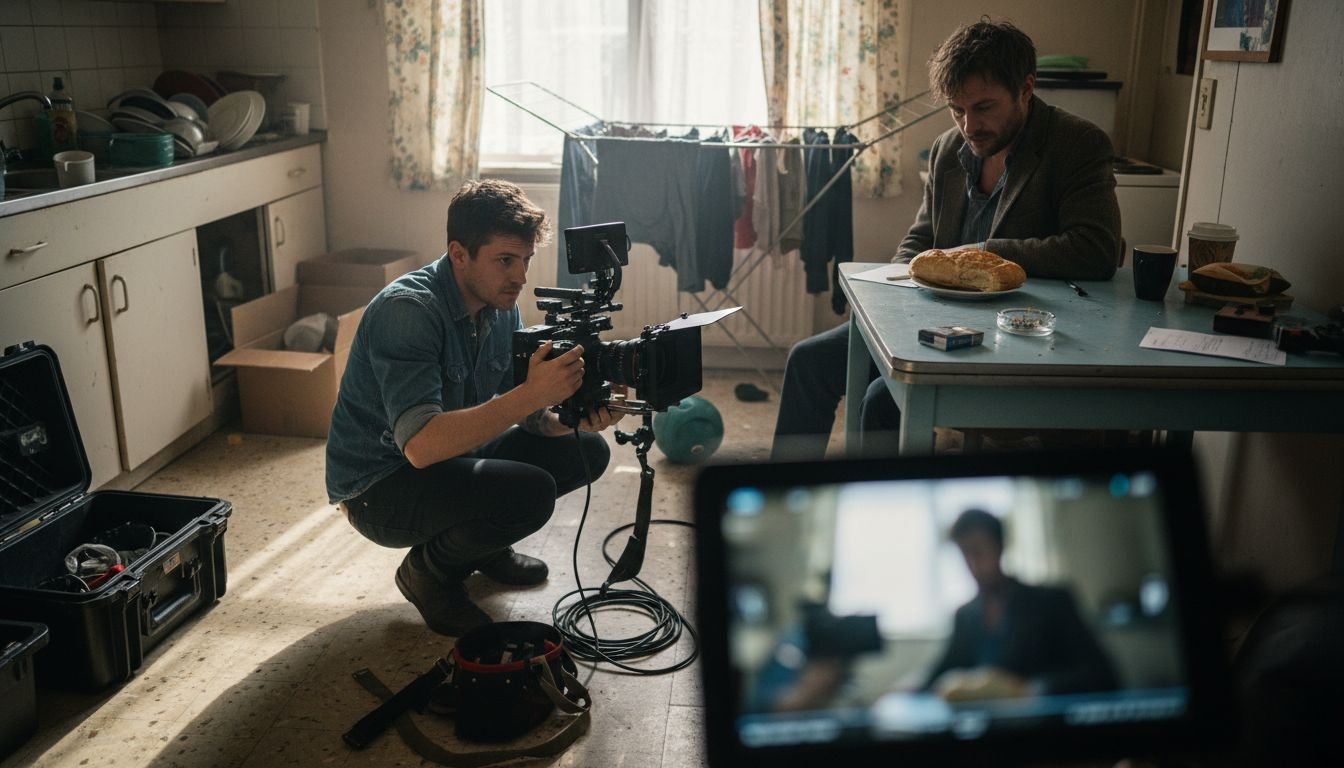
Handheld cameras meant filmmakers could follow actors into real spaces, capturing genuine reactions rather than staged performances. Natural lighting meant no waiting for crews to rig elaborate equipment—just available light from windows and street lamps.
On-location shooting did something revolutionary: it made films feel alive. Parisian streets became characters themselves, weather patterns shaped scenes, and everyday chaos enriched the visuals.
Key technical approaches:
- Lightweight 16mm equipment that freed directors from studio constraints
- Faster film stocks enabling shooting without artificial lighting
- Portable sound recording allowing naturalistic dialogue capture
- Minimal crew reducing interference between camera and reality
Breaking Narrative Convention
Fragmented, non-linear storytelling and jump cuts rejected the three-act formula entirely. New Wave directors embraced ambiguous endings, letting audiences form their own conclusions.
Linear plots disappeared. Instead, films wandered through character consciousness, following thoughts rather than events. A character might spend twenty minutes simply walking through a city, observing rather than acting.
Jump cuts created jarring transitions—cutting from one moment to another without smooth transitions. Rather than disorienting, this technique reflected how human consciousness actually works. Your mind jumps between thoughts. Why shouldn’t cinema?
Improved dialogue sounded like genuine conversation, not scripted exposition. Characters interrupted each other, changed subjects abruptly, and left thoughts unfinished—exactly like real people.
Thematic Depth Through Form
These formal innovations weren’t separate from meaning. Structure embodied theme. A fragmented narrative mirrored fragmented modern consciousness. Jump cuts captured emotional dislocation. Long, unbroken takes emphasised observation over action.
Films like ‘The 400 Blows’ used these techniques not as stylistic flourishes but as expressions of their subject matter: adolescent confusion, alienation, and searching.
New Wave filmmakers understood that form and content merge—how you tell a story matters as much as what the story is.
Practical Application for Contemporary Work
These innovations established principles that still govern modern filmmaking. Location shooting over studio sets. Naturalistic performance over theatrical delivery. Editing that respects emotional time rather than rushing the narrative.
Understanding these techniques helps you recognise when to use them and when convention serves your story better.
The following table summarises how New Wave technical choices support their deeper artistic aims:
| Technique | Intended Effect | Artistic Purpose |
|---|---|---|
| Handheld camera | Heightened immediacy | Connects audience with reality |
| Jump cut editing | Narrative fragmentation | Mimics real thought patterns |
| On-location shooting | Visual authenticity | Merges film with actual life |
| Natural lighting | Raw, unstaged look | Underscores emotional realism |
| Improvised dialogue | Conversational tone | Portrays genuine relationships |
Pro tip: Analyse ‘Breathless’ or ‘The 400 Blows’ shot-by-shot, noting why directors chose particular camera angles, editing rhythms, and dialogue moments. This teaches you decision-making far better than any theoretical framework.
Ongoing Legacy in Contemporary Filmmaking
The New Wave didn’t fade into history. Its influence permeates contemporary cinema so thoroughly that most modern filmmakers operate within frameworks those 1950s directors established.
When you watch a contemporary film, you’re watching the New Wave’s descendants—whether the director knows it or not.
How New Wave Principles Shape Today’s Cinema
The New Wave provided a speculative vision of the future through cinematic innovation and urban representation, influencing contemporary directors’ approaches with a spirit of youthful rebellion and aesthetic experimentation. This wasn’t merely stylistic influence—it fundamentally redefined what cinema could be.
Contemporary filmmakers inherited several core principles:
- Auteur cinema: Directors as primary creative voices, not studio functionaries
- Location authenticity: Real spaces over constructed sets
- Narrative freedom: Rejecting formulas in favour of personal vision
- Visual immediacy: Handheld work, natural light, unpolished aesthetics
- Thematic complexity: Ambiguity over neat resolution
These aren’t trendy choices anymore. They’re foundational.
The Auteur Theory’s Lasting Impact
Aesthetic innovations and auteur theory reshaped filmmaking in France and beyond, with influence persisting across decades. Before the New Wave, studios owned films. Directors executed studio decisions.
The New Wave flipped this entirely. Directors became authors. Their personal vision mattered more than commercial calculation. This shift enabled contemporary filmmakers like the Safdie Brothers, Greta Gerwig, and Lynne Ramsay to stake complete creative claims over their work.
Without the New Wave redefining the director’s role, contemporary independent cinema wouldn’t exist as we know it.
Visible Influence in Current Practice
Consider what’s happening in contemporary film right now. Streaming services greenlight character-driven narratives with ambiguous endings. Emerging filmmakers shoot on location with minimal crews. Dialogue-heavy films about ordinary people’s internal struggles find audiences.
These aren’t accidents. They’re direct descendants of New Wave thinking.
The New Wave transformed narrative and stylistic norms so completely that its innovations became invisible—they’re simply how cinema works now.
What This Means for Your Development
Understanding the New Wave’s legacy helps you recognise which creative choices you inherit and which you actively choose. When you decide to shoot on location or embrace narrative ambiguity, you’re making informed decisions, not following unconscious patterns.
Recognising these inherited principles allows you to work with them intentionally—or deliberately against them.
Contemporary directors like Christoph Hochhäusler demonstrate how New Wave principles evolve through contemporary practice, blending classical aesthetic innovation with modern concerns and technologies.
Pro tip: Watch three contemporary films and three classic New Wave films back-to-back, actively noting technical and narrative similarities. This trains your eye to spot inherited influence and understand when you’re choosing tradition versus invention.
Misconceptions and Common Challenges
The New Wave carries romantic baggage. Film students often imagine it as a unified movement with fixed rules, when reality was messier and far more interesting.
Understanding the actual complexities helps you avoid repeating misconceptions in your own work.
The Famous Directors Problem
The French New Wave is often perceived through its most famous directors, which oversimplifies the movement’s diversity and complexity. When you think of the New Wave, you probably picture Godard and Truffaut. But dozens of other directors contributed equally important work that shaped cinema just as profoundly.
This narrow focus creates problems. It suggests the New Wave was about specific stylistic choices when it was actually about something broader: a shared spirit of experimentation and auteurism.
Consequences of this misconception:
- Emerging filmmakers assume they must replicate Godard’s jump cuts or Truffaut’s nostalgia
- Critics dismiss films that don’t match the “New Wave look” as failures
- Film education oversimplifies a complex, diverse movement
- Younger directors feel pressure to work within inherited formulas rather than forge new paths
The “Unified Style” Myth
People think the New Wave had a consistent aesthetic. Wrong. The movement was less defined by fixed style than by shared spirit of experimentation. Hou Hsiao-hsien’s long takes look completely different from Jean-Luc Godard’s fragmented editing, yet both embodied New Wave principles.
Regional New Waves faced additional complications. Regional New Waves faced different challenges articulating identity, complicated by economic and political pressures that shaped how filmmakers worked differently across nations.
What connected them wasn’t aesthetic similarity—it was attitude.
The Sustainability Challenge
The New Wave was brief. This brevity created problems that scholars still grapple with. Without a sustaining doctrine or manifesto, the movement lacked coherent identity for historians to study.
This creates real challenges for your understanding. You can’t simply absorb New Wave principles like a rulebook. Instead, you must develop a philosophical approach—prioritising personal vision over commercial formula, authenticity over artifice, experimentation over safety.
Avoiding These Traps
Don’t mistake aesthetic imitation for understanding. Handheld cameras and jump cuts don’t make your film “New Wave.” The approach—challenging convention, prioritising vision, embracing risk—defines the actual legacy.
Regional contexts matter enormously. What worked for French directors in the 1950s requires radical reimagining for your circumstances, technology, and audience.
The New Wave’s true inheritance isn’t visual style—it’s permission to question everything about how cinema functions.
Practical Mistakes to Avoid
Common errors emerging filmmakers make:
- Using New Wave techniques without understanding their purpose
- Assuming aesthetic similarity creates thematic depth
- Ignoring regional variations and cultural context
- Treating the movement as a style rather than a philosophy
- Forgetting that the movement embraced commercial viability alongside artistic innovation
Pro tip: Study a lesser-known New Wave director alongside the famous ones—analyse how their approach differs stylistically yet shares the same philosophical foundation. This trains you to recognise principle over aesthetic similarity.
Discover How New Wave Cinema Can Inspire Your Creative Vision
Struggling to break free from traditional filmmaking rules and eager to embrace the bold spirit of New Wave cinema, the movement’s emphasis on authenticity, personal vision and innovative storytelling techniques offers invaluable insight for any modern filmmaker or cinephile
Explore in-depth film reviews and insightful interviews that unravel the craftsmanship behind auteurs like Rivette and Godard. Gain the inspiration to incorporate handheld camera work, natural lighting, and narrative freedom into your projects now and start transforming your understanding of cinema today
Frequently Asked Questions
What defines New Wave cinema?
New Wave cinema is characterised by a radical departure from conventional filmmaking, emphasising authenticity, naturalism, and innovative narrative structures. It prioritises personal artistic vision over commercial formulas.
How did New Wave filmmakers challenge traditional storytelling?
New Wave filmmakers employed techniques such as handheld camera work, non-linear editing, and ambiguous endings to create a more intimate and immediate connection with audiences. This disrupted the conventional three-act structure and allowed for more reflective storytelling.
What are some key visual techniques used in New Wave films?
Key visual techniques include the use of handheld cameras for real-life immediacy, natural lighting for a raw aesthetic, and on-location shooting to enhance authenticity and context. These choices create a sense of realism that resonates with viewers.
How have New Wave principles influenced contemporary filmmaking?
New Wave principles continue to shape modern cinema by promoting the importance of the director as the primary creative voice, encouraging narrative freedom, and valuing location authenticity over studio sets. These innovations have laid the groundwork for the film styles we see today.