Kantemir Balagov’s long-awaited third feature, Butterfly Jam, confirms what hisit first two only suggested: that the emperor’s wardrobe deserves closer inspection.
The critical consensus around Balagov has always been slightly ahead of the evidence. Closeness (Tesnota) (2017) and Beanpole (Dylda 2019) arrived trailing Sokurov’s name and a FIPRESCI prize, and the festival circuit did what it invariably does: treated the provenance as proof of the work. Both films had some qualities: physical intensity, a willingness to sit in discomfort, and an eye that occasionally found something genuine in the frame. But the scriptwriting was overextended, and the emotional mechanics were laboured in ways the enthusiastic reception largely chose to overlook. There were also major ethical problems, not least in the first feature. Butterfly Jam, Balagov’s English-language debut, is a more straightforward disappointment: it confirms those doubts without the mitigating qualities.
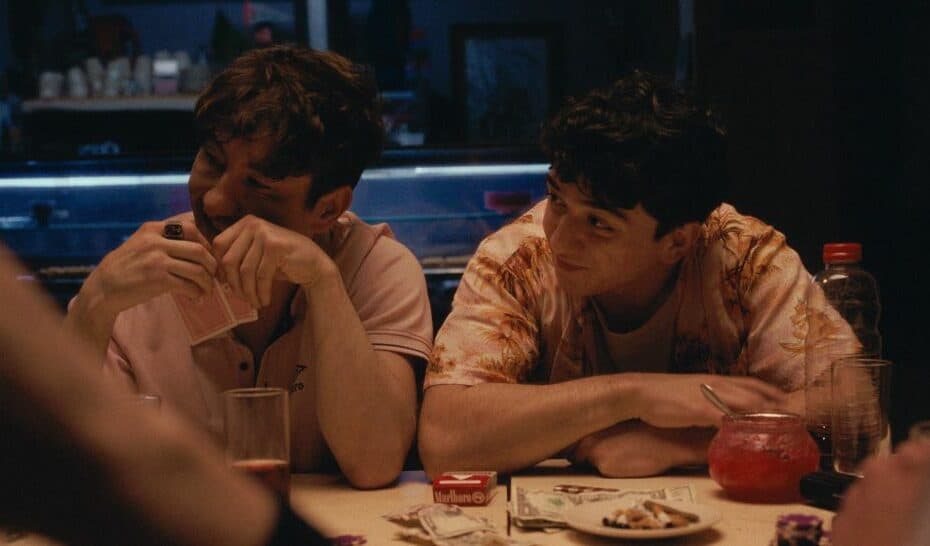
The setting is Newark, New Jersey. The community is Circassian, exiled Russians navigating the particular humiliations of diaspora life: a failing restaurant, codes of masculinity that don’t survive transplantation, a teenage son trying to locate himself between two sets of expectations he didn’t choose. Pyteh (Talha Akdogan), sixteen, wrestles competitively and watches his father, Azik (Barry Keoghan), careen between charm and volatility. That’s the dramatic architecture. It isn’t necessarily uninteresting. With a well-written script, this might have been interesting, or at least watchable.
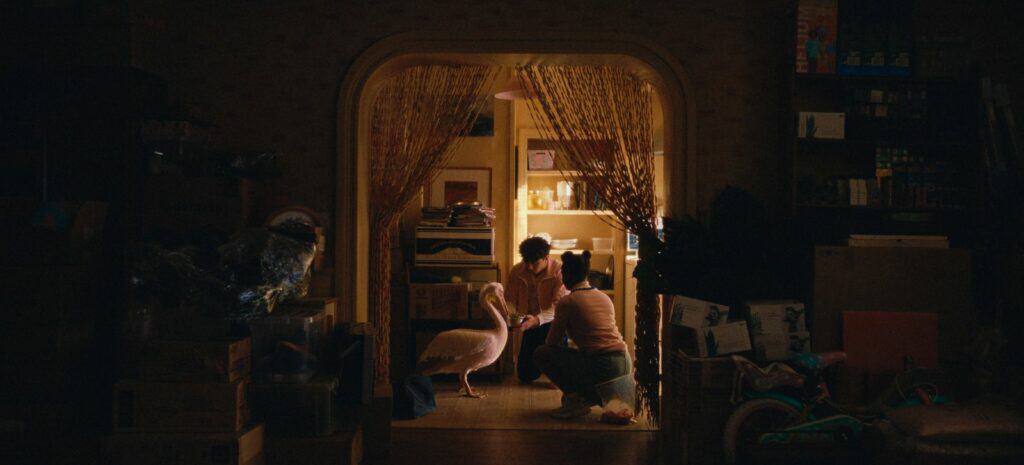
They got caught in a celluloid Butterfly Jam
The problem is that Balagov and co-writer Maria Stepnova don’t trust the material to do its work. The script funnels what should be ambient pressure into conspicuous incident, and the thematic concerns, toxic masculinity, the violence fathers visit on sons, the myths communities build around their dead, are flagged with a thoroughness that forecloses the viewer’s participation. When a film tells you, twice and carefully, what it is about, the response is less illumination than impatience. The Safdie brothers might be an uncharitable point of comparison, given the New Jersey milieu and the tempo of accumulating crisis, but the Safdies rarely mistake busyness for intensity. Here, the mechanics show.
The casting exacerbates the problem. Barry Keoghan, playing Azik, has become synonymous with a particular register of unpredictable danger, and Balagov deploys him accordingly, meaning predictably. Keoghan works hard, but he’s working against a character conceived as a function rather than as a person, undermining the film’s bid for authenticity. Riley Keough is given almost nothing: a watchful wife on the periphery of scenes that don’t include her. Harry Melling fares better, and one or two of his moments approach something genuinely unsettling, but even he is finally in service of the script’s architecture rather than liberated by it. Talha Akdogan, as Pyteh, is left to carry the film’s emotional weight with the least support from the writing.
Cinematographer Jomo Fray, whose work elsewhere has demonstrated real intelligence, is here constrained by a visual conception that mistakes self-consciousness for rigour. The framing is deliberate to the point of paralysis; compositions announce themselves as compositions. There’s a quality of craft demonstrating itself that runs through the film from first frame to last, and it has the effect of distancing the viewer from whatever emotional transaction Balagov is attempting. The Sokurov influence, which in Closeness occasionally produced something genuine, has here calcified into mannerism, quickly leading to boredom.
What remains is a film that mistakes cultural specificity for depth, and deliberate pacing for earned contemplation. The Circassian milieu is genuinely under-represented on screen, and that should count for something, but representation isn’t an argument. Butterfly Jam offers a coherent idea of what a good film about this community might look like, without coming close to achieving that film. The Quinzaine des cinéastes has opened stronger, and it’s understandable that the film was not selected for the official part of this year’s Cannes Film Festival.