Everytime is a film of devastating formal precision, and the best film shown at Cannes 2026. ★★★★★
Sandra Wollner’s third feature opens with the kind of domestic ordinariness that, in retrospect, functions as a trap. Jessie (Carla Hüttermann) is a teenager, lively and present; her mother, Ella, played by Birgit Minichmayr, is stretched thin but attentive; the younger sister, Melli (Lotte Shirin Keiling), shares a room and resents it, as younger sisters do. The texture is recognisable enough to lower your guard.
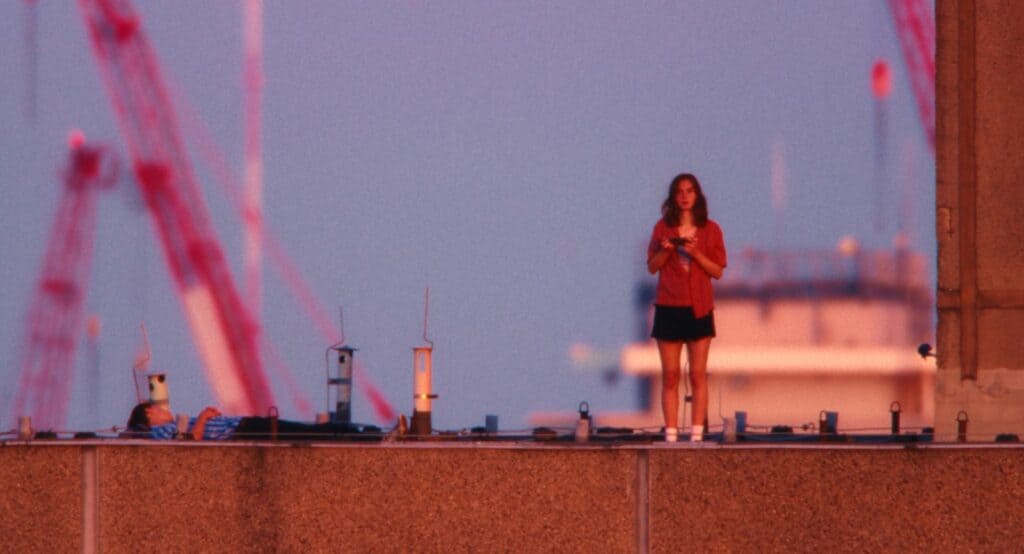
Then, during a night out, Jessie’s boyfriend Lux falls asleep drunk on a rooftop, and she falls to her death. Cinematographer Gregory Oke, who also shot Aftersun (2022), follows her gaze onto a loosely soaring bird before the camera travels back to find her body in silent freefall. It’s executed with such casual candour that you briefly doubt your own eyes. This is the first of Wollner’s gasp-inducing cinematic coups. It will not be the last.
When Does Wollner Get It Right? Everytime
In her debut, Das unmögliche Bild, a character observes that “our memory is so unreliable, sometimes what we see might as well be the future.” That The Trouble with Being Born deepened this preoccupation, and that Everytime is its fullest realisation, tells you something about a filmmaker who has now made three consecutive films of genuine distinction.
The formal achievement is difficult to describe, partly because describing it risks making it sound more effortful than it appears. Wollner studied documentary filmmaking, and her strategy is to ground the first half in documentary reality so completely that the audience extends it unconditional trust: the characters are streetwise, the texture unglamourised, nothing romanticised. Then she turns the corner. What lies beneath the concrete surface comes up, and a new reality of sorts folds into existence. You only understand what has happened when you try to locate yourself and find you can’t.
What follows is a grief film that refuses the topic’s conventional grammar. Ella takes the family south to Tenerife, where the sun is bright, and Oke’s cinematography softens into something almost fugue-like without ever losing its grip. There, they encounter a young girl who seems, in some way the film declines to specify, connected to Jessie. The family gravitates toward her; at moments they behave as though she actually is her. Wollner offers no explanation, and none is needed.

Central to this is Vintage Story, a voxel-based sandbox game that Jessie played before her death. For Ella and Lux, it becomes a kind of digital monument, a space they can re-enter where she was once present. The game’s blocky, Lego-like geometry gradually bleeds into the film’s own visual language in ways better experienced than described. Oke’s soft, occasionally fuzzy cinematography is doing the same work as the editing: dissolving the membrane between what was, what is remembered, and what the eye now sees.
The sound design operates by the same logic. Wollner’s partner composed a single piano theme when she first told him the story; it runs through the entire film, threading the temporal layers together. Beneath it, the meditative, faintly uncanny music of Vintage Story overlaps with Jessie’s own playing, inner and outer reality bleeding into each other before the images have quite caught up.
The closest comparison in terms of formal mastery is perhaps her compatriot, Jessica Hausner, even though their approaches to cinema differ. Hausner’s control is palpable, while Wollner’s is more felt in retrospect. You do not sense the architecture while you are inside it. That Everytime is her third consecutive film of genuine distinction, following Das unmögliche Bild and The Trouble with Being Born, suggests a filmmaker not only in full command of her formal vocabulary but expanding it with each work. At a moment when formal ambition in European arthouse cinema is more often performed than achieved, that consistency is worth noticing.

Minichmayr is, as she invariably is, the most compelling presence in any room she enters. What is remarkable here is that the film itself operates at the same altitude. Ella’s grief is rendered with a subtlety that never shades into withholding; you feel the full weight of it through her behaviour, her glance, and the particular quality of her attention toward the young girl in Tenerife. It is a performance that earns its restraint. The whole cast is formidable, and the same could be said of the film surrounding it.
That Everytime was placed in Un Certain Regard rather than the main competition reveals more about festival programming logic than about the film’s qualities. One understands how these things work: a director whose previous work divided opinion, a film that resists easy description. What is harder to understand is how a selection committee that screened Everytime concluded it belonged anywhere other than the Palme d’Or race. It won Un Certain Regard. It should have been given the chance to be robbed of the Palme d’Or.