Gentle Monster is neither gentle nor monstrous; it is something worse: timid and passive-aggressively vindictive. ★☆☆☆☆
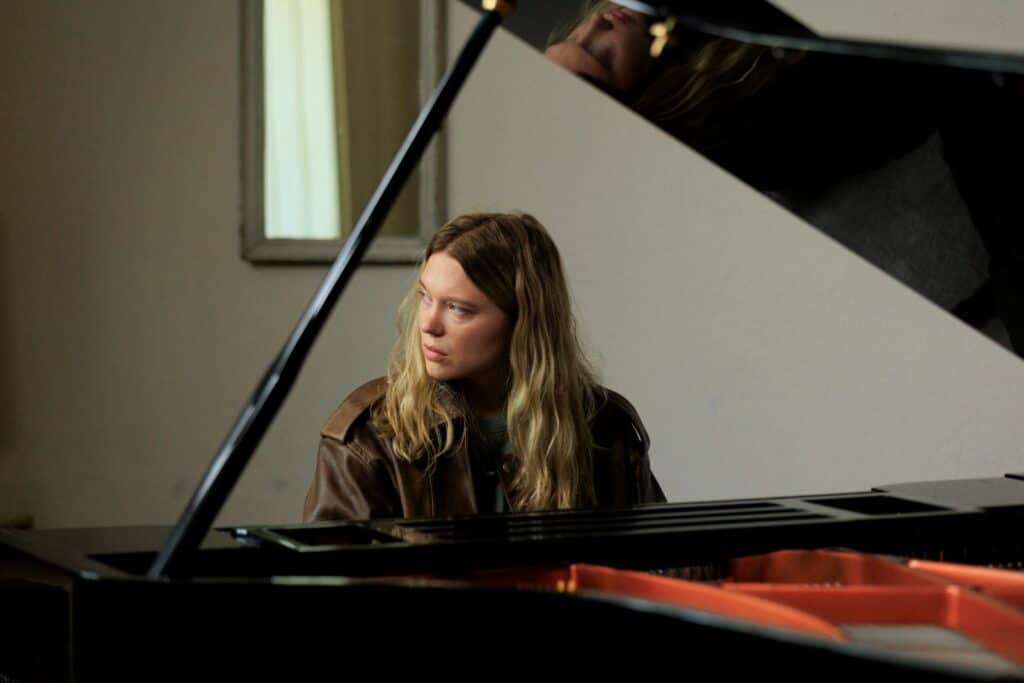
Gentle Monster, directed by Marie Kreutzer and starring Léa Seydoux, screened in the main competition at the 2026 Cannes Film Festival. Following her previous film, Corsage, Kreutzer returns with another prestige drama that attempts to tackle dark and uncomfortable subject matter. The result is one of the most disappointing films of this year’s competition, and that says a lot. Léa Seydoux plays Lucy Weiss, a gifted pianist who has put her career on hold to support her husband Philip (Laurence Rupp), a filmmaker. After moving to the countryside with their young daughter, the family’s seemingly idyllic life is shattered when the police reveal that Philip has been involved with child sexual abuse material.
What follows is nearly two hours of Lucy’s emotional collapse: crying, denial, rage, and disintegration, while the film circles the same limited set of ideas without ever daring to go deeper. The fundamental problem with Gentle Monster is its timidity. Kreutzer seems unwilling to truly confront the monstrous reality at the centre of the story. Philip remains a blurry, underdeveloped figure, more of a narrative device than a human being. Instead of exploring the psychology of denial, complicity, or the horrifying banality of evil, the film opts for repetitive scenes of Seydoux emoting in “beautifully” lit interiors. After the fourth or fifth breakdown, the emotional weight evaporates, leaving only padding.
Who is the Gentle Monster
As so many times before, one wonders what happened to script doctors. The writing here is lazy beyond belief. When you think it can’t get any worse, a pointless parallel storyline involving a female detective is introduced, which adds little besides runtime. The symbolism is heavy-handed, and the film lacks any formal boldness or cinematic intelligence. The strong cast cannot save it either. This film and L’Inconnue prove that Seydoux is too often way better than the films she acts in. As she proved in The Story of My Wife, she can be stunning in a demanding part, but here she fights not only a bad script, but a director who doesn’t seem to know what she is doing.
As always, her performance is technically proficient, but she can’t save this film. Nothing else could either. The result feels like misguided Oscar bait that mistakes misery for meaning. Gentle Monster wants to be seen as a serious and unflinching examination of trauma and moral blindness. In reality, it is a hollow and overly tasteful drama that lacks courage, depth, and originality. In a weak Cannes competition, it still stands out, but for all the wrong reasons. This is not elevated drama. It is middlebrow prestige cinema at its most disappointing.
Now, with her sixth feature film, Kreutzer still doesn’t seem to get anywhere. It’s all too clear that she is a filmmaker who remains stuck, unwilling or unable to push beyond surface-level prestige conventions into something riskier and more insightful. It’s hardly a surprise that it’s not cinematically illuminating either.
The film’s personal undercurrent becomes especially uncomfortable in the closing credits, which include a pointed thanks to “the haters” who targeted Kreutzer in 2023. This is a clear reference to the scandal involving Florian Teichtmeister, the actor who played a major role in her previous film, Corsage and was later convicted in connection with child sexual abuse material. By weaving this real-life experience into the fabric of Gentle Monster, Kreutzer seems to be processing her own collateral damage in a story that mirrors the very situation she faced. Yet this meta-layer only highlights the film’s timidity: it draws from painful reality but still refuses to dig into the uncomfortable truths with the necessary sharpness or honesty.