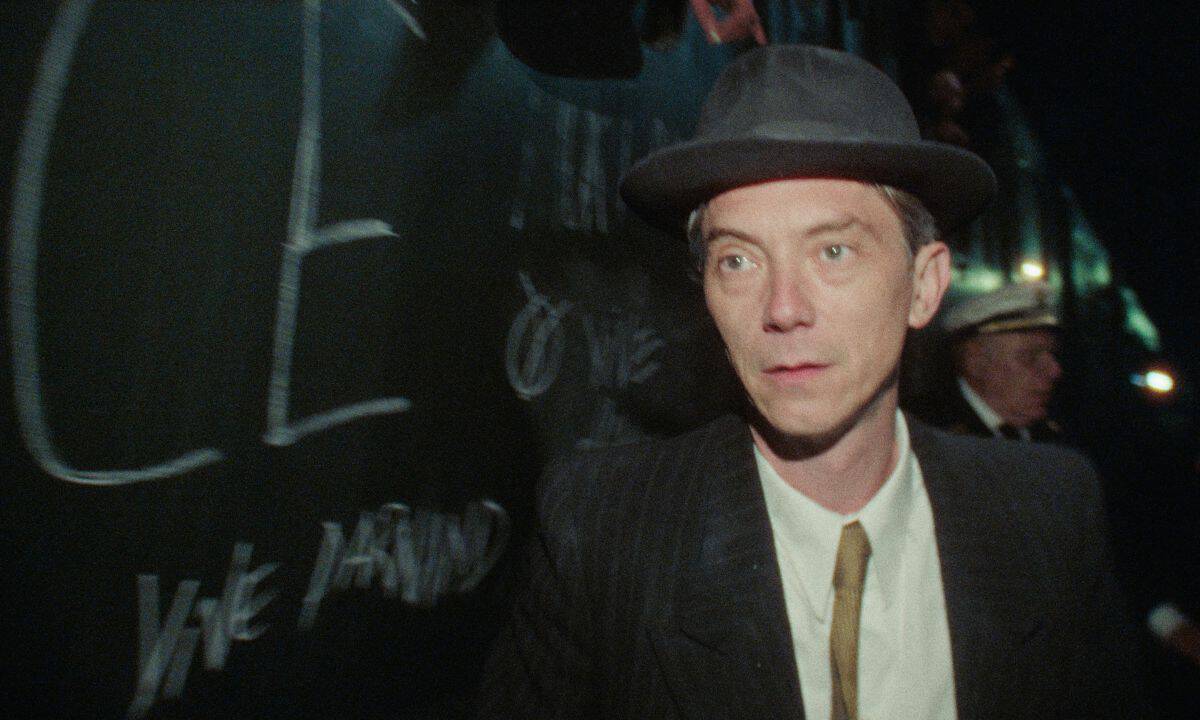
Moulin is the latest film by László Nemes, which premiered at this year’s Cannes Film Festival competition. The director mentioned the project when I interviewed him in Venice last year, but I didn’t expect the film to be finished this soon. This biographical film chronicles the story of Jean Moulin (Gilles Lellouche), who is parachuted into Nazi-occupied France to unite the fractured Resistance groups under Charles de Gaulle. Despite his efforts to remain hidden, he is eventually betrayed and delivered to the Gestapo in Lyon, led by the ruthless Klaus Barbie (Lars Eidinger). Moulin is subjected to torture, but psychological tactics as well. Will he succumb to the pressure or remain silent?
The answer won’t surprise anyone who knows the facts about Jean Moulin, whose case has been the subject of several reports and books. What Nemes is interested in is not the outcome but the texture of resistance, the clandestine meetings, the assumed identities, the grinding bureaucratic machinery of occupation. In this, he succeeds rather well. The film is methodical, whereas another director might have been breathless and matter-of-fact instead of straining for grandeur. There is no triumphant score swelling at the moments of heroism, no attempt to beatify its subject. Moulin is treated as a man doing what needed to be done, which is ultimately more respectful and affecting than a hagiography would have been.
The style of Moulin
Lellouche is well cast precisely because he resists the temptation to play Moulin as a monument. His performance is inward, watchful, almost bureaucratic in its own way: a man who has learned to keep his face unreadable. Lars Eidinger, as Klaus Barbie, is chilling in a different register: controlled, almost banal, which is of course the point. Both actors understand that restraint is the most powerful tool available to them, and both use it well. The supporting cast holds the same discipline: no one reaches for effect, no one signals their significance in advance.
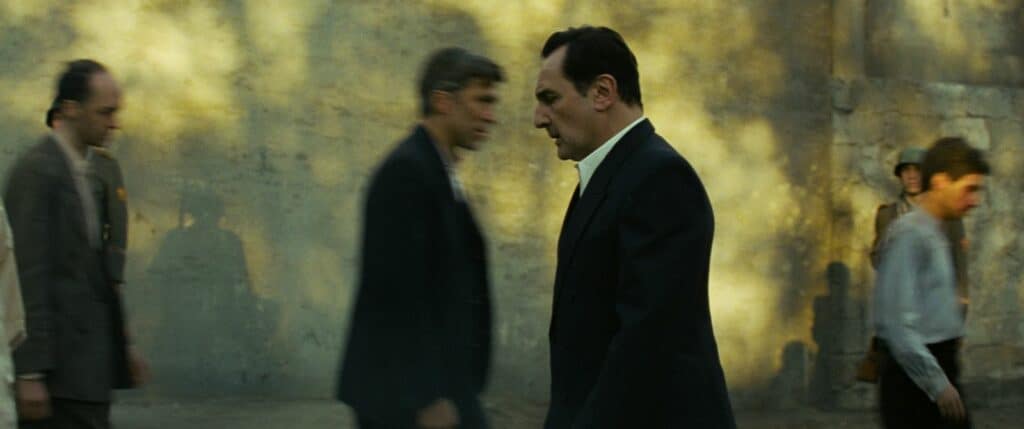
This matters more than it should because the French contingent in this year’s competition demonstrated, with some consistency, that a film can be impeccably French in manner and almost entirely inert in effect. Bourgeois-Tacquet’s A Woman’s Life (La Vie d’une femme) is the kind of film that mistakes a well-dressed cast for an argument. Marre’s Notre Salut (A Man of His Time) mistakes 155 minutes for weight. Another example of a failure is Arthur Harari’s The Unknown (L’Inconnue). That Moulin, technically a French production, is, in practice, a Hungarian film in its rigour, its patience, and its refusal to flatter the audience, is either a rebuke or an irony, depending on your disposition.
The film is Nemes’s first in French and his seventh collaboration with cinematographer Mátyás Erdély, a partnership that has now produced one of the most coherent and distinguished bodies of visual work in contemporary European cinema. Their relationship began, as so many things in Hungarian film do, in the short-film world: Erdély shot Bálint Kenyeres’s Before Dawn (2005), a film that won the Jury Prize at Sundance and screened at over 140 festivals, and it was on that set that he and Nemes first met.
Their subsequent shorts together, beginning with With a Little Patience (Türelem 2007), quietly laid the grammatical groundwork for Son of Saul. Tight framing, shallow depth of field, the camera locked to a body navigating an environment it cannot fully see or process. That film’s Academy Award and Grand Prix at Cannes announced Erdély to the world at large. However, he had been one of the most consistently interesting cinematographers working in Hungary for years before it.

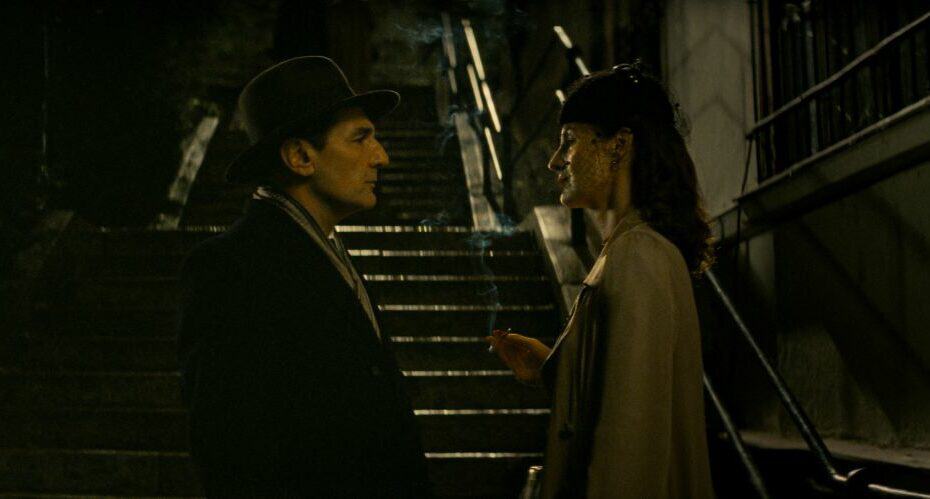
For Moulin, Erdély shoots in 35mm anamorphic CinemaScope, a choice that feels both principled and exactly right. The wide frame fills naturally and unhurriedly with the period texture of occupied Lyon: lamplight pooling on wet cobblestones, cigarette smoke suspended in half-lit rooms, shadows stretched long across alleyways that seem to narrow the longer you look at them. A bleach-bypass process applied in post-production at NFI Filmlab in Budapest further drains the palette, giving the image a washed, slightly airless quality that suits the material without announcing itself as a stylistic choice.
The grain of 35mm does what digital cannot replicate: it gives the past a physical presence, a materiality that makes the story feel less reconstructed than inhabited. Moulin is the best-lensed film in this year’s competition, by a mile. That Nemes chose to film in Hungary, using Hungarian technical infrastructure, is fitting for a director who has never quite belonged to a single national cinema. Moulin is a French story told with the precision and austerity of the Hungarian filmmaking tradition: unhurried, undecorated, alert to the weight of history without being crushed by it.
In a competition not short of earnest prestige pictures, it stands apart as the film that earns its seriousness, and the one most likely to last. It is also a reminder that the tradition running from Jancsó all the way to Nemes is one of the most consistently rigorous in European film, and that rigour, applied to French history and French actors, turns out to travel extremely well. Moulin left the festival empty-handed. Considering the quality of the other contenders, that could be seen as surprising, but in the current context, unfortunately, it isn’t. Suffice to say that the Palme d’Or has gone to much worse films during the last decade.