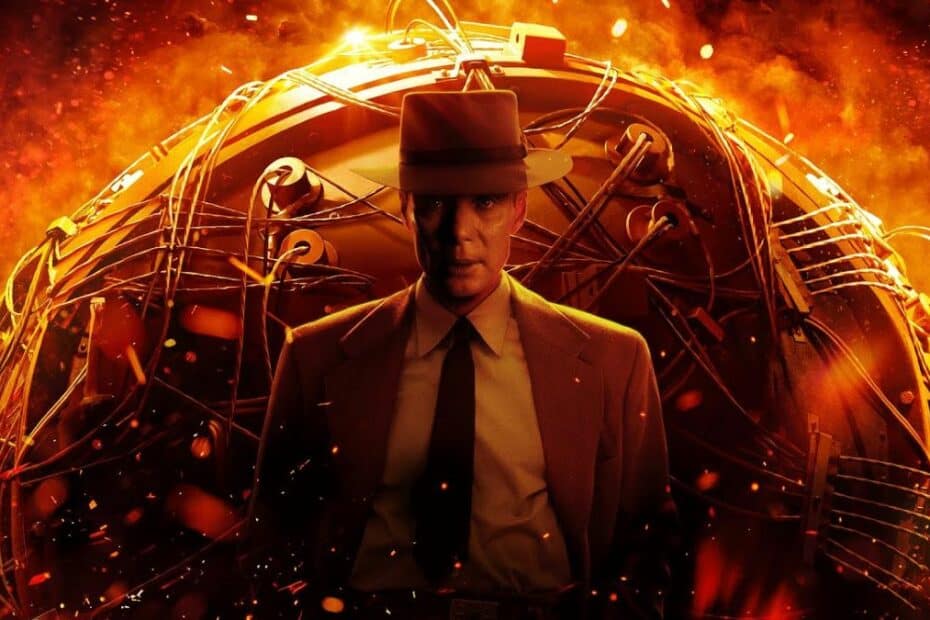
Christopher Nolan builds a film that splits and fuses exactly like the physics it depicts, and, for once, his structural gamesmanship does genuine thematic work rather than performing purported cleverness for its own sake. ★★★★☆
I am, on the record, not a Nolan enthusiast. His films tend to mistake structural cleverness for depth, and Tenet remains a personal low point I have written about at length elsewhere on this site. Oppenheimer (2023) is therefore something of an ambush. It is the best work Nolan has made, and the reasons why are worth taking seriously rather than simply celebrating.
The film tracks J. Robert Oppenheimer from his early studies under Niels Bohr and Werner Heisenberg’s shadow through his recruitment to head Los Alamos, the Manhattan Project’s race against a German bomb that never materialises, and the Trinity test itself. It then splits its attention across two postwar hearings: the closed-door security clearance review that strips Oppenheimer of influence over the weapon he built, and Lewis Strauss’s (Robert Downey Jr.) Senate confirmation, where the consequences of that earlier hearing circle back on their architect. The film moves between these timelines rather than through them in sequence. A stylistic choice not unknown to Nolan’s fans.
Oppenheimer’s Form is split, yet coherent
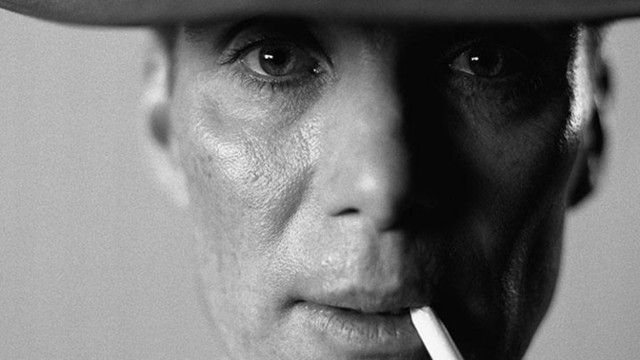
The decision to structure the film around Fission and Fusion, colour and monochrome, subjective and objective, is genuinely inspired given the subject matter. A biopic about the man who built the bomb organised around the two nuclear processes that made it possible is the kind of formal idea that could only work for this specific film about this specific life. My only real complaint is that Nolan names the sections outright rather than trusting the audience to feel the split. The structure is elegant enough not to need the caption – show, don’t subtitle.
Hoyte van Hoytema’s cinematography is extraordinary throughout, moving between IMAX-scale grandeur and claustrophobic interiority without either register feeling like a stunt. The Trinity test sequence earns its reputation. What further elevates the visual work is its integration with Ludwig Göransson’s score, one of the most impressive pieces of film composition in recent memory. Longtime readers may recall my semi-serious suggestion, in my Tenet review, that it would have worked better as a musical built around ELO’s Time—incidentally, an album whose narrator is also credited merely as the Protagonist. Oppenheimer needs no such rescue.
Göransson’s music does the work Tenet’s screenplay never managed, carrying argument and dread in melody rather than in exposition, and Jennifer Lame’s editing threads score and image together with real precision, cutting on rhythm as often as on action so that the two feel like a single instrument rather than two tracks laid over each other.

Cillian Murphy is the film’s centre of gravity, and he is genuinely stunning in the role. He plays Oppenheimer as a man perpetually one step removed from his own consequences, charismatic in rooms and hollow the moment he is alone, and Murphy sustains that duality for the entire runtime without ever tipping into either warmth or self-pity. It is a performance built on withholding, which is precisely what the character requires. Emily Blunt is also good as Kitty Oppenheimer, even if she has considerably less material to work with.
Florence Pugh, in considerably less screen time, delivers pure feline sexuality as Jean Tatlock, coiled and unpredictable. Some critics greeted this with the usual hand-wringing about gratuitous sexualisation, which rather misses what Nolan is actually doing. I sighed when I saw Pugh’s name in the credits, but for once, her presence works. Tatlock’s sexuality is not incidental to the film’s argument; it is bound up with Oppenheimer’s own vulnerability and the parts of himself he cannot control any better than he can control the weapon he unleashes. Pugh understands this even where some critics apparently did not, and the performance is sharper for refusing to be tidy.
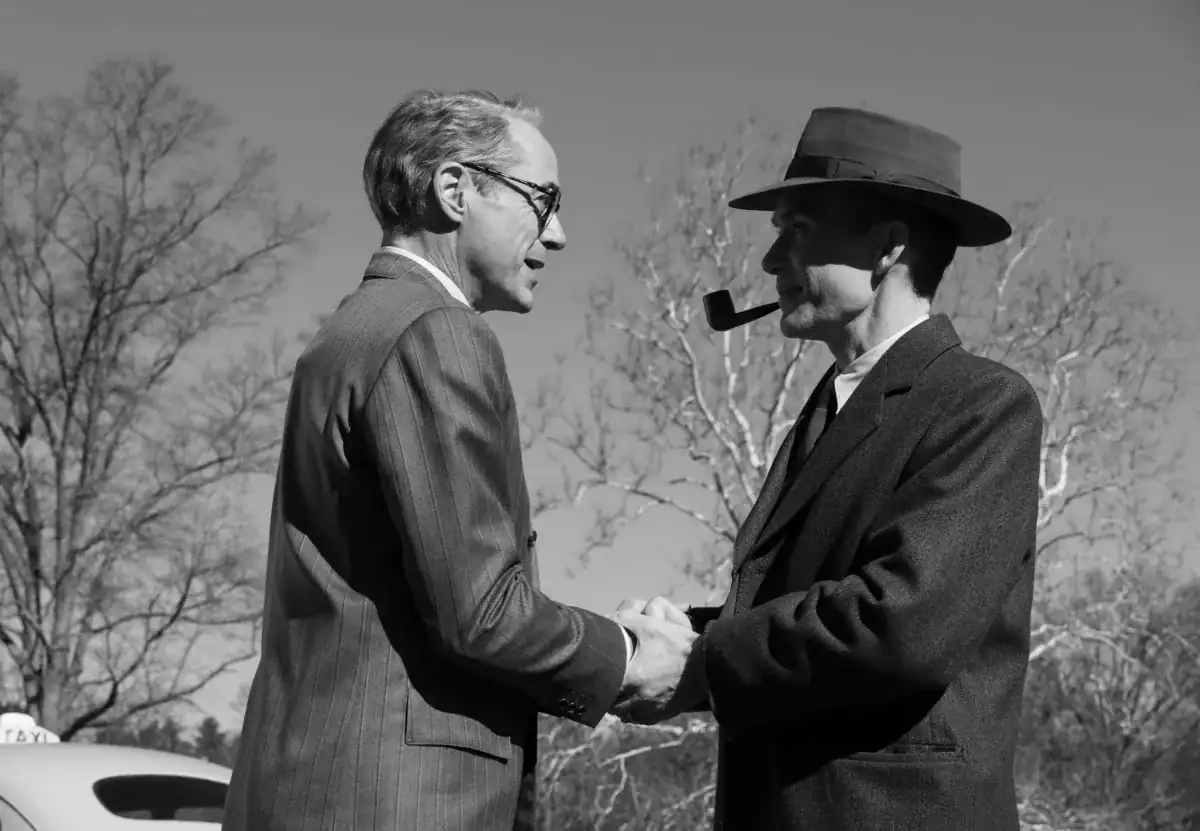
Robert Downey Jr, on the other hand, is a problem the film never solves. His Strauss is stiff and telegraphed from his first scene, an actor visibly performing “villain” rather than a man discovering he might be one. Every beat lands exactly where you expect it to, which is presumably why the Academy rewarded it with the Oscar: nothing communicates prestige acting quite like a performance you can see coming from the lobby. It is the safest kind of good, the sort that wins awards precisely because it asks nothing of the viewer.
Rami Malek fares no better, and his brief appearance does him no favours. He is, obviously, an actor with an extremely limited range, and here he is given only a handful of scenes. He delivers exposition with the same fixed intensity regardless of what the moment requires, and his late plot-relevant reveal lands with less weight than it should because the performance has given the audience nothing to invest in beforehand.
None of this undoes what Nolan achieves elsewhere. This is a film about moral catastrophe that trusts its audience to sit with ambiguity rather than resolution, anchored by a lead performance that will be the reference point for Oppenheimer on screen for a long time. The caveats are real, but they are caveats to a genuine achievement, not qualifications of one.