I saw Mark Jenkin’s third feature, Rose of Nevada (reviewed here), in the Orizzonti section of the Venice Film Festival. Three years after the interview in Cannes 2022, I had another opportunity to meet him and talk about his new work and cinema in general.
The Premiere
The Disapproving Swede: This must have been the biggest premiere you’ve had so far. How did it feel? It felt great just being there as a spectator.
Mark Jenkin: I felt anxious when the film started. Then, during the storm sequence, I realised that I was feeling anxious for the characters on the screen, not for myself anymore, which I thought was a good thing; my suspension of disbelief had actually allowed me to get lost in the film. Then there was the standing ovation afterwards. I’ve never had that before.
TDS: How did that feel? Was it a bit strange as well?
MJ: It was great! Still, it is difficult to know what to do. I think time just stood still for me.
TDS: Like in the film….or maybe rather the opposite of the film.
MJ: Yes. My mom and sister were there, so it was amazing to be there for that.
TDS: How was the Q&A?
MJ: Somebody asked me yesterday what my favourite part is in making films, since I’m involved in everything. I said this because, when talking about it, all the hard work’s done, so the Q&A is a joy for me.
Rose of Nevada and the earlier films
TDS: Three years ago, a student asked you about Enys Men: “What the hell did I just watch?” So, if I were to ask you, what did I watch?
MJ: I don’t know. I haven’t read enough reviews to know what I’ve watched.
TDS: I have read a few. I’m asking because I’ve spoken to some critics who said they were not so keen on Enys Men, but really loved this one and Bait. Which one do you think it’s most similar to, or do you feel that you just move forward?
MJ: Well, I hope I go forward, but Mary [Woodvine] said to me that for her, it feels like a combination of the two. In the same way that if you read the Bait script, you’d have no idea what the film was gonna look like.
TDS; But that was because of production problems, no? You were supposed to have two boats, for instance.
MJ: But also, it’s very linear the way the script is written, and the temporal shifting within that film happened in the edit. It’s not in the script, whereas with Enys Men, the temporal shifting is within the script but has no logic or pattern to it. With Rose of Nevada, it’s one temporal shift that is the driver of the whole film. Additionally, on a more surface level, there’s the kitchen-sink drama element of Bait, which is also present in Rose of Nevada. Still, there’s the slightly supernatural element of Enys Men, which is there as well.
TDS: There are many fewer societal elements in Enys Men than in this
MJ: Yeah, yeah. So the first half an hour of Rose of Nevada could be just a straight kitchen sink drama. I got a message from somebody who said it feels like the trilogy is complete now. They’d like to screen the trilogy to show the progression. They mean that it could be the same story because there are overlapping themes.
TDS: When we discussed Enys Men, you mentioned that at one point, you were concerned it was too linear, until you saw the cast screening and thought it was “pretty out there”. How do you feel about Rose of Nevada? It’s more specific in the way that you know where the time jump is going and where they are, in a way.
MJ: Yes, but there are still time jumps within the structure…
TDS: Absolutely.
MJ: Time jumps which are not in the script. There are two examples with George’s [MacKay] character. None of those were in the script, but I’m open to those things during editing.
TDS: Which of your films changed the most during the editing process?
MJ: I would say it was the same for all of them. The changes in the edit happen because of the way I shoot, and I shot all three of them in the same way.
TDS: And with the same camera, but I read that it’s dead now. I’m sorry for your loss. Did you bury it at sea or something?
MJ: It is dead. I’ve still got it; it’s clockwork, so the spring is broken. Maybe one day the man who services my cameras will find another one.
Mark Jenkin’s first big production
TDS: Can you talk about the production? This is obviously a more expensive film.
MJ: The budget is like 20 times the budget of Enys Men, I think, but I preserved the way that I worked. The BFI became involved for the first time, and they ended up giving us a substantial part of the budget. I think it was a much bigger proposition for Denzil [Monk, the producer]. I didn’t notice any difference at all, apart from the fact that we had more time and a much bigger team.
TDS: What about working with two name actors like George MacKay and Callum Turner?
MJ: Yes, the two main differences were the size of the art department and, obviously, working with those two actors.
TDS: Did they know your work?
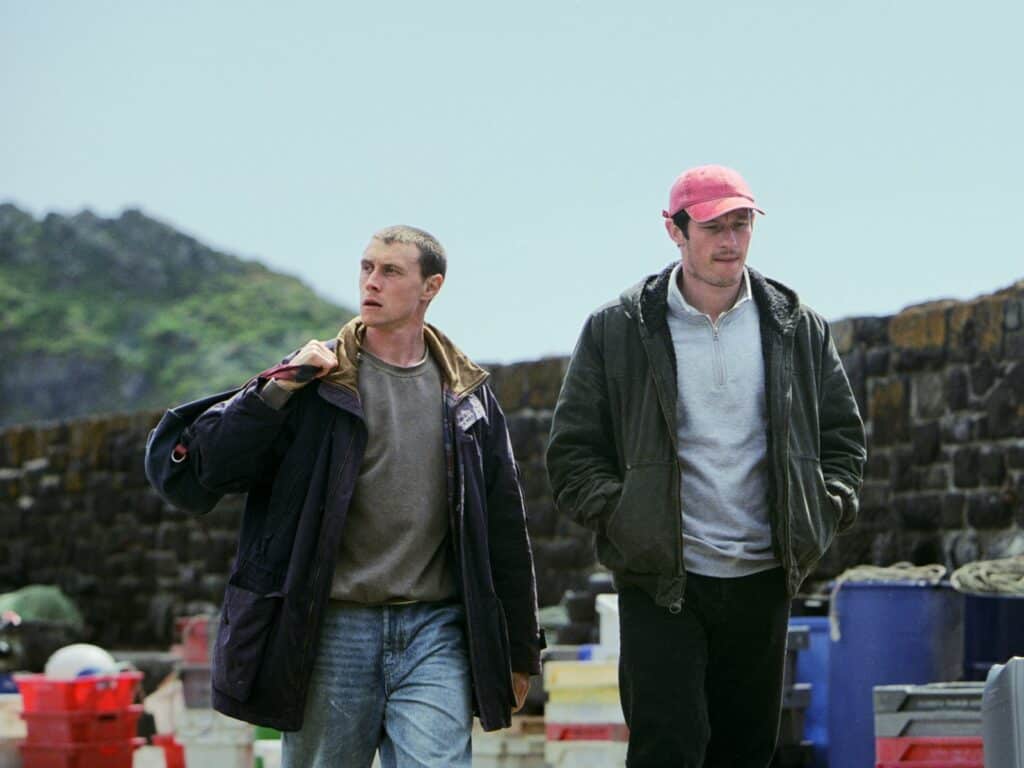
MJ: Callum knew my work, and we met through a mutual agent. I knew about George for a long time. I met with him, and I was thinking of him for the part of Liam, but as soon as I met George, I thought, No, he’s Nick. Then I met Callum, and I thought that they could work together. On the surface, they were so different, but as I got to know them, I realised that they’re actually similar in many ways. That made me realise that the two characters could be thought of as two halves of one person. Or, certainly, binary opposites who shift positions within the time slip. That clarified a lot about those characters.
TDS: There was nothing they found strange about your work, or something they were not used to?
Mj: No, to start with, I thought I’m gonna have to sort of hide how odd the way I work is, but then I realised that they were there for the oddness, they wanted to do something different. I think George is constantly challenging himself with the people he works with.
TDS: He was extraordinary in Bonello’s The Beast.
MJ: Yes, not least when he had to shoot himself with an iPhone and things like that. He is obviously open to development and experimentation. Callum was really intrigued by the way I worked. He’s a real cineast. He watches everything. So he knew about me. He knew that I work in a pretty batshit crazy way. So he was there for that rather than it being a normal production. In some ways, it was a massive change, but as soon as they were here, there was no difference in the form.
The form of Rose of Nevada
TDS: And there you mentioned the operative word, form. How would you describe the formal conceits in Rose of Nevada. There were some Bresson touches for sure, not least in the beginning.
MJ: Yes, he is never far away. When I wonder how to do something, I think, “How would Bresson do it?” The answer is doing some close-ups, so that’s the formula. I guess I try not to think about the form too much, even though it’s essential. I follow my gut, and the method is the same each time.
TDS: Isn’t the editing slightly different this time?
MJ: I don’t know, do you think it is?
TDS: It felt like it developed in some ways.
MJ: Well, I hope so.
The Technological aspects
TDS: What about the film stock?
MJ: It was precisely the same as the stock we used on Enys Men. One of the varieties was the 500T Tungsten stock, which is the grainiest one. In an ideal world, I’d shoot everything on the 500T because it’s a grittier stock. But with the camera I use, because the viewfinder isn’t very big and we’re not using monitors, to use it outside in bright sunlight, we’d need to use so much neutral density ND filter behind the lens. That means that I really wouldn’t see anything in the viewfinder. Next time, I may restrict myself to using the 500T to get the film even grainier and work out a way to monitor it somehow.
TDS: The colours are really pronounced.
MJ: I really love the colours in the negative, and then we really push it in the colour grading. I worked with a fantastic colour grader, Michael Todd. In the post, we push the negative as far as it will go.
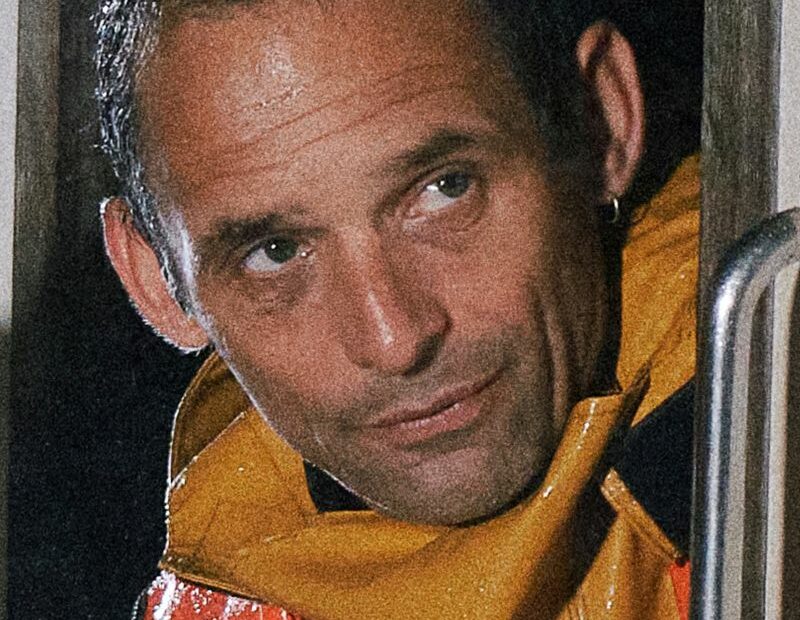
For me, the primary colours are the key to the film. Red is significant in this film again, and I love the combination of blue and yellow, especially with the oilskins worn by the fishermen against the blue sky or the blue of the sea. I want anything red in the frame to pop.
What makes a film good?
TDS: I’ve seen so many bad films here, and suddenly you watch this and think, “It’s not so difficult to make a great film, after all.”
MJ: I was talking about this yesterday. It’s like capturing lightning in a bottle. You don’t need much bad luck for the film to be bad. You don’t need many things to make a film that isn’t successful, so I think the less you try to do, the less chance there is for something to go wrong.
TDS: The less you try to complicate things, you mean?
Yes, if you concentrate on making it simple, then you can’t go wrong. I think all you need is a camera, some actors, and light. There’s still the potential for everything else to go bad. Your script can be crap, or interfered with, or you can get the edit wrong. If you keep the form simple, that’s one less thing to get wrong. I see some things that are so complicated.
TDS: I like how the societal aspects are congenial with the form. It never becomes preachy, but you still strongly feel what these people are going through.
MJ: I hope so. Someone called it bleak, but I think that the context sometimes has to be for the small
amount of hope to become more distinct. When we were watching rough cuts, some people thought there was too much focus on the fishing process. I tried to take a bit of the fishing out, but by doing that, the fishing became boring; it felt longer, even though there was less of it.
Also, with the sound design, I decided to make it more repetitive, harder to listen to, and more oppressive. I wanted the sounds to permeate people, and I wanted to really emphasise how difficult, dangerous, boring, and repetitive the fishing is. All, for it to have that kind of peace afterwards, and those moments of quiet and the moment of contemplation. That’s really scary for me to think it’s so easy to get it wrong in the edit.
TDS: Interestingly, people always want to edit things out, but that can actually make things feel longer. Some of Jacques Rivette’s four-hour films are released in a two-hour version, and those versions feel much longer and boring, since the context and structure are broken. It’s not only about deleting things.
MJ: It’s not, you can make films longer by making them shorter, definitely. On the other hand, there are instances where I can cut a frame off, and it’s too short, or I could add a frame and it’s too long, and that’s nuts because that’s 1/24th of a second, but it’s so elusive as well, which is great because it’s like there’ll never be a perfect film. That’s why I have to make another one. That is why I love Bresson; I love L’Argent because I don’t know any other director whose best film was also his last. He couldn’t get any more Bresson than L’Argent.
TDS: Finally, I have to ask about that expression “orifice of knowledge” said by one of the characters. Where did that come from?
MJ: I used to work in a cafe when I was a teenager. The person who owned the cafe was very knowledgeable about various things, and a kid who worked at the cafe said to him one day, “You’re an orifice of knowledge”. What he meant to say was you’re an oracle of knowledge.
TDS: That sounds more like a place where knowledge disappears.
MJ: (Laughing) Yes, like it gets sucked into it. Anyway, I always loved it, and I thought that one day I would use it.