
Releasing a film only to face unexpected rating hurdles can be both confusing and frustrating. For related reading, see our guide to essential cinema vocabulary. For independent filmmakers and festival organisers, a clear understanding of rating systems is pivotal to reaching wider audiences without compromising creative vision. These frameworks are not government censorship but voluntary guidelines designed to inform parents and protect artistic expression. Gaining insight into their true nature helps you sidestep common misconceptions and make more confident distribution choices.
Table of Contents
- Defining Film Rating Systems And Misconceptions
- Major Rating Types And Cross-Country Variations
- How Rating Processes And Criteria Differ
- Legal And Market Implications For Filmmakers
- Common Challenges And Navigating Restrictions
Key Takeaways
| Point | Details |
|---|---|
| Understanding Film Ratings | Film rating systems provide important guidance without imposing legal restrictions, serving as tools for informed decision-making by audiences and parents. |
| Global Variations | Different countries exhibit diverse film rating systems, reflecting unique cultural norms and societal values, impacting content accessibility. |
| Navigating Challenges | Filmmakers face challenges from inconsistent criteria across regions, necessitating strategic planning and flexibility to ensure successful distribution. |
| Economic Pressures | Compliance with film ratings heavily influences filmmakers’ decisions, balancing creative integrity with commercial viability in a competitive market. |
Defining Film Rating Systems and Misconceptions
Film rating systems represent sophisticated mechanisms designed to provide viewers, especially parents, with essential guidance about the content and age-appropriateness of cinematic productions. Contrary to popular misconceptions, these systems are not tools of governmental censorship but voluntary frameworks designed to help audiences make informed viewing choices.
The Motion Picture Association established its rating system in 1968, creating a voluntary framework through independent parent classifications. This system offers critical insights into film content without legally mandating restrictions. The key characteristics of film rating systems include:
- Providing parents with content awareness
- Offering age-appropriate viewing recommendations
- Maintaining a voluntary, non-governmental approach
- Protecting artistic expression while informing audiences
Several widespread misconceptions persist about film rating systems. First Amendment research highlights that many people incorrectly believe these systems involve government intervention or detailed filmmaker feedback. In reality, rating processes remain private, subjective assessments conducted by independent panels.
Film ratings offer guidance, not legal restrictions. They represent a collaborative approach to helping audiences navigate diverse cinematic content.
Rating systems typically categorise films based on potentially sensitive content such as violence, sexual themes, language, and mature situations. The classifications aim to empower viewers, particularly parents, to make educated decisions about media consumption without imposing absolute restrictions.
Pro tip: When evaluating film ratings, consider them advisory tools rather than absolute prohibitions, and use them as conversation starters about media content with younger viewers.
Major Rating Types and Cross-Country Variations
Film rating systems demonstrate remarkable diversity across global contexts, with each country developing unique approaches to classifying cinematic content. Most countries maintain distinct rating mechanisms that reflect their specific cultural norms, legal frameworks, and societal standards for media consumption.
The Motion Picture Association in the United States provides a comprehensive example of a sophisticated rating system. Their categories include:
- G: General audience
- PG: Parental guidance suggested
- PG-13: Parents strongly cautioned
- R: Restricted
- NC-17: No children under 17 admitted
Global rating systems reveal fascinating variations in how different nations approach content classification. European countries typically employ more nuanced age-based systems, while Asian nations often have more stringent content restrictions. The United Kingdom, for instance, uses classifications such as U, PG, 12A, 15, and 18, each representing a specific level of audience appropriateness.
International film rating systems are not universal but represent complex cultural negotiations about media consumption and audience protection.
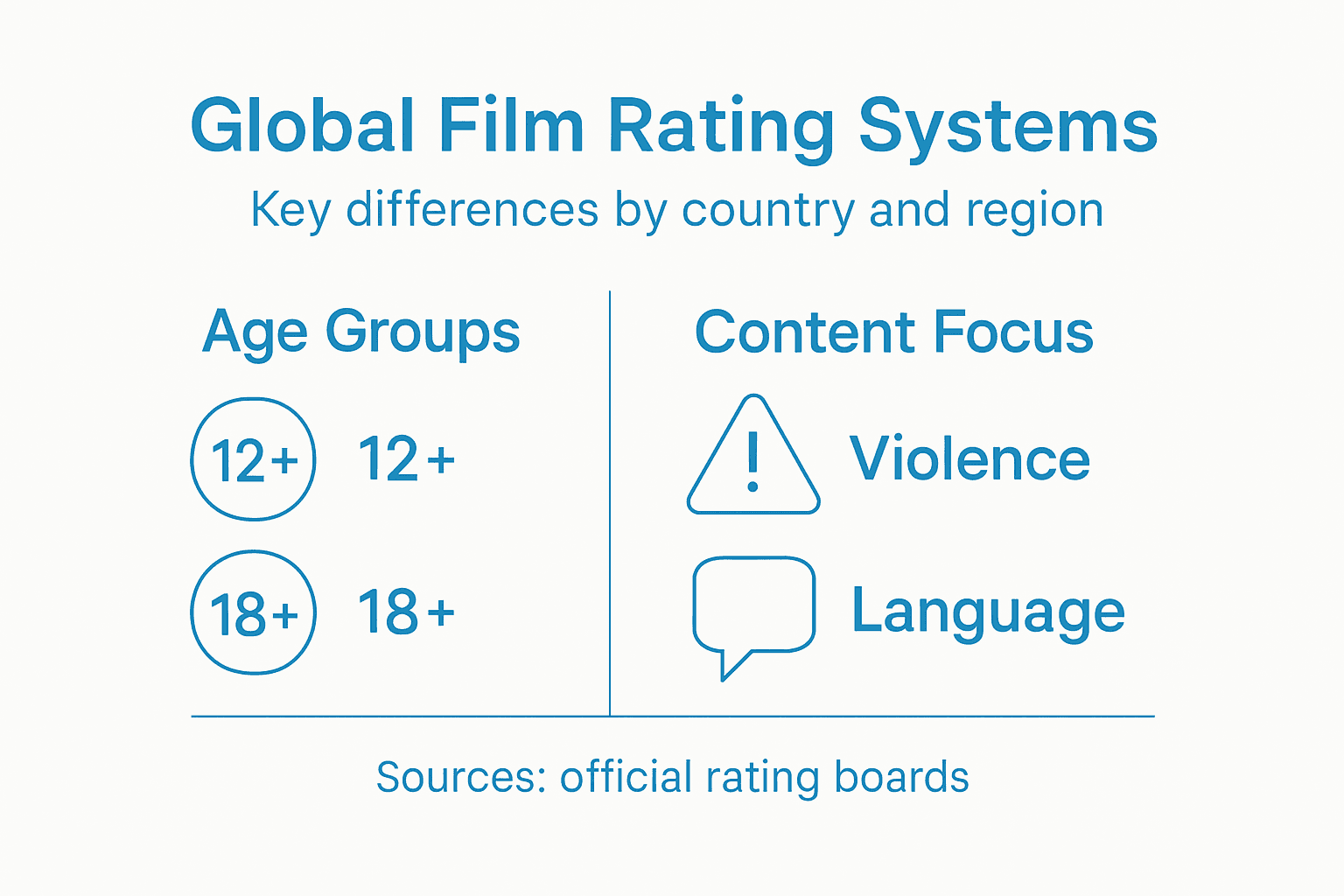
Cultural differences significantly impact rating criteria. Some nations focus extensively on violence, while others prioritise sexual content or language restrictions. Countries like Germany and Australia have particularly detailed rating systems that consider multiple content dimensions, including psychological impact and potential audience sensitivity.
Pro tip: When distributing films internationally, always research the specific rating requirements for each target market to ensure compliance and appropriate audience targeting.
To clarify cross-cultural differences, here is a comparison of film rating systems in key markets:
| Country/Region | Age Categories Used | Primary Review Body | Content Focus Priorities |
|---|---|---|---|
| United States | G, PG, PG-13, R, NC-17 | Motion Picture Association (CARA) | Language, violence, sexual content |
| United Kingdom | U, PG, 12A, 15, 18 | British Board of Film Classification (BBFC) | Violence, drug use, sexual content |
| Germany | 0, 6, 12, 16, 18 | FSK (Voluntary Self-Regulation) | Psychological themes, violence, impact on youth |
| Australia | G, PG, M, MA15+, R18+ | Australian Classification Board | Sexuality, language, adult themes |
How Rating Processes and Criteria Differ
Film rating methodologies represent complex administrative processes that vary dramatically across different cultural and regulatory landscapes. The Classification and Rating Administration (CARA) in the United States exemplifies how independent bodies evaluate cinematic content, providing a nuanced approach to film categorisation.
The primary criteria for rating films typically encompass several key dimensions:
- Intensity of violent content
- Sexual themes and nudity
- Frequency and context of profane language
- Drug and alcohol references
- Psychological and emotional complexity of themes
- Potential psychological impact on younger viewers
International rating processes exhibit significant variation in their approaches. Some countries employ government agencies for film classification, while others rely on industry-led panels. European nations often utilise more comprehensive evaluation frameworks that consider cultural sensitivities and potential societal impacts in greater depth than purely content-based assessments.
Rating systems are not uniform legal instruments but nuanced cultural negotiation tools that reflect societal values and audience protection mechanisms.
The transparency and methodology of rating processes differ substantially. In the United States, the process remains voluntary and relatively opaque, with filmmakers able to contest or modify ratings. Conversely, countries like Germany and Australia have more structured, legislatively supported systems with clearer appeal mechanisms and more explicit content guidelines.

Pro tip: Always request detailed feedback when receiving a film rating, as understanding the specific criteria can help filmmakers make strategic editing decisions.
Legal and Market Implications for Filmmakers
Film rating systems present complex market dynamics that significantly impact filmmakers’ creative and commercial strategies. Although technically voluntary, these rating mechanisms create powerful economic pressures that shape production decisions and distribution opportunities.
The key market implications for filmmakers include:
- Restricted audience accessibility
- Limited theatrical distribution channels
- Potential advertising constraints
- International market entry barriers
- Financial investment risks
- Marketing strategy modifications
Compliance with rating systems offers crucial economic incentives. Theaters frequently refuse to screen unrated or heavily restricted films, effectively forcing filmmakers to navigate these complex regulatory landscapes. This creates a nuanced ecosystem where creative vision must be balanced with commercial viability.
Economic pressures within film rating systems transform artistic decisions into strategic market calculations, compelling filmmakers to anticipate audience and distributor expectations.
International film distribution introduces additional complexity, with rating requirements varying dramatically across different cultural contexts. European markets often have more stringent content evaluation processes, while North American systems provide relatively more flexibility. Independent filmmakers must develop a sophisticated understanding of these varied frameworks to navigate global cinema markets successfully.
Pro tip: Consult international film distribution experts early in your production process to understand potential rating challenges and strategically plan your film’s market positioning.
Common Challenges and Navigating Restrictions
Film rating systems present intricate challenges for independent filmmakers, creating complex navigational landscapes that demand strategic creative decision-making. The subjective nature of content evaluation means filmmakers must anticipate and proactively address potential rating complications.
Key challenges filmmakers consistently encounter include:
- Inconsistent rating criteria across jurisdictions
- Subjective interpretations of content boundaries
- Cultural biases in content evaluation
- Potential financial penalties for restrictive ratings
- Creative compromises required for broader distribution
- Varied international market expectations
Navigating rating restrictions requires a sophisticated understanding of content modification strategies. Filmmakers often develop nuanced approaches such as creating multiple edit versions, strategically managing sensitive scenes, and understanding regional content sensitivities.
Artistic integrity becomes a delicate negotiation between creative vision and market accessibility in the complex world of film rating systems.
International film distribution introduces additional complexity, with rating requirements varying dramatically across cultural contexts. European markets frequently employ more stringent evaluation processes, while North American systems offer relatively more flexibility. Successful independent filmmakers must develop comprehensive strategies that balance artistic authenticity with commercial pragmatism.
The following table summarises key challenges filmmakers face and potential strategies for addressing them:
| Challenge | Impact on Filmmaker | Common Mitigation Strategy |
|---|---|---|
| Inconsistent global criteria | Limits international reach | Prepare region-specific edits |
| Subjective content interpretation | Unpredictable ratings | Seek early feedback |
| Cultural evaluation biases | Creative restriction | Collaborate with local advisors |
| Financial risks from restrictions | Reduced revenue | Plan alternative distribution |
Pro tip: Maintain multiple edit versions of your film with varying content intensity to provide flexibility across different rating systems and market requirements.
Navigate Film Ratings with Confidence and Insight
Understanding the complexities of film rating systems can be a challenge for any cinema enthusiast or filmmaker. This article reveals key struggles, such as navigating international rating differences and overcoming subjective content evaluations, that impact how films reach their audiences. If you seek to deepen your knowledge of film classifications and explore how these ratings influence cinematic experiences around the world, discover comprehensive film reviews and exclusive interviews that unpack these issues.
Explore rich insights into cinema and uncover honest perspectives at Disapproving Swede. Our detailed reviews and interviews help you appreciate the nuances behind ratings and storytelling, allowing you to stay informed and make thoughtful viewing choices today. Do not miss out on grasping the subtleties of global film systems by visiting Disapproving Swede now, and enrich your cinema journey with us.
Frequently Asked Questions
What are film rating systems?
Film rating systems are frameworks that help viewers, particularly parents, determine the appropriateness of film content. They categorise films based on sensitive content, such as violence and sexual themes, to guide without imposing legal restrictions.
How do film ratings differ between countries?
Film ratings vary significantly across countries, with each nation developing its own system that reflects cultural norms and content sensitivities. For example, some countries focus more on violence, while others prioritise sexual content or language restrictions.
What are the main criteria used to determine a film’s rating?
The main criteria for ratings typically include the intensity of violent content, sexual themes, frequency of profanity, drug references, and the psychological complexity of themes. Each rating body may weigh these factors differently, contributing to inconsistencies across regions.
How can filmmakers navigate challenges related to film ratings?
Filmmakers can address rating challenges by preparing multiple versions of their films, seeking early feedback on potential rating issues, and understanding the specific content sensitivities in different markets to ensure broader distribution.
Recommended
- 7 Key Insights for Choosing Best International Film – The Disapproving Swede
- TENET – It was about time – A review in the 11:th hour. Bad
- The 10 films with the highest Disapproval rating 2025 Disapproving
- Berlinale 2019 Systemsprenger is tense but goes badly wrong.