Interior is the first feature by Pascal Schuh. The film follows Kasimir (Daniil Kremkin), a young burglar who hides inside a hollow couch to infiltrate people’s homes and secretly record their most intimate moments. He delivers the recordings to the enigmatic neurosurgeon Dr Liebermann (Knut Berger), who watches them, purportedly to study human emotions, but the process is done in an eerie, ritual-like fashion. It seems that he himself wants to learn how to feel human emotions. The word “burglar” can be questioned, since Kasimir doesn’t steal any items, but rather private moments. The rules are simple but strict. Under no circumstances is he allowed to intervene in what happens, no matter how dire the situation might be.
The relationship between Liebermann and the mute Kasimir is far from idyllic and shows clear signs of abusive behaviour. Still, they seem to need each other. Every evening, they watch the recorded videos together while eating a meal comprised of fish sticks. The aforementioned ritual aspects are reinforced by the way those scenes are framed and lit. The situations Kasimir experiences will take a toll on his conscience. At one point, Dr Liebermann says, “A person needs feeling people to become a feeling person themselves”. This points to something deeply lacking within him, which he seems to think can be solved by scientific means. Incidentally, that is an approach that is not uncommon in other walks of life, including filmmaking.
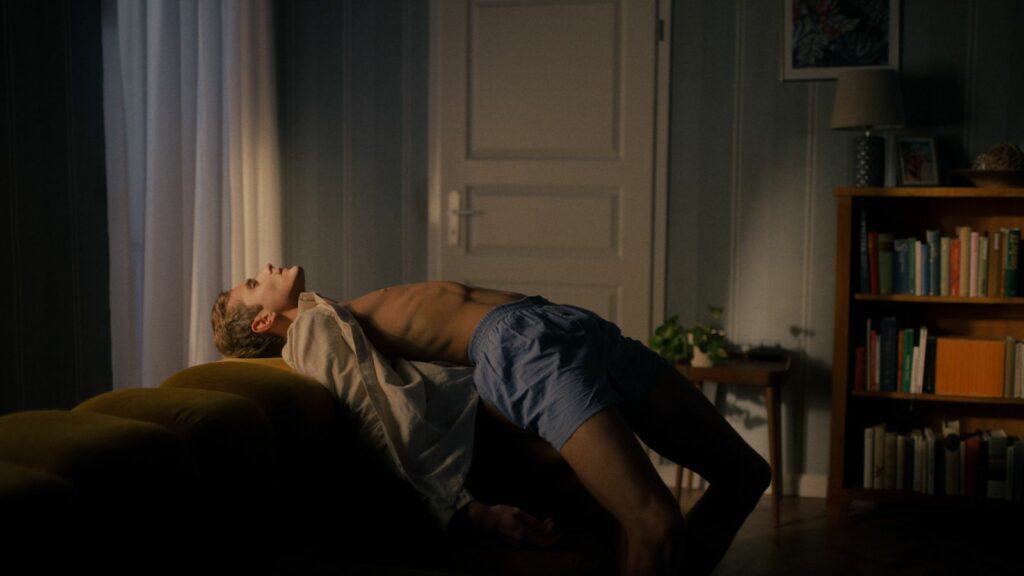
Gratuitous Sax & Senseless Violence? 1A reference to the Sparks album, which was a hit in Germany.
A famous musician, more precisely, a saxophone player (Andreas Nickel), consults Dr Liebermann. The sessions play out in a weird manner, and eventually end up with the doctor claiming that the sole solution for the musician’s ails is surgery of a very unusual kind. It is far from the only offbeat element in this carefully crafted film. If the setup sounds familiar (One could think of Peeping Tom (1960) or Caché (2005), it is soon evident that this film has many surprises within its form. What makes the film exceptional is that those surprises all turn out to be well-earned and fit perfectly within the Interior of the film’s meticulous structure.
When I interviewed Pascah Schuh and producer Timo Ackermann, they both emphasised the film’s collective aspect and the importance of everyone working on Interior. There are indeed several splendid elements in the film, from Greta Isabella Conte’s cinematography, the production design (Olga Gredig & Lore Walter), the editing (Frederik Franke), and the score (Erik Johann Fode). Those are merely a few examples of why the film works as well as it does. Knut Berger and Daniil Kremkin are pitch-perfect in their roles, all the way down to the sign language. That all those facets work so well together is a testament to Pascal Schuh’s skill as a director and writer. “Das sind nicht zu große Schuh(e) für Pascal.”
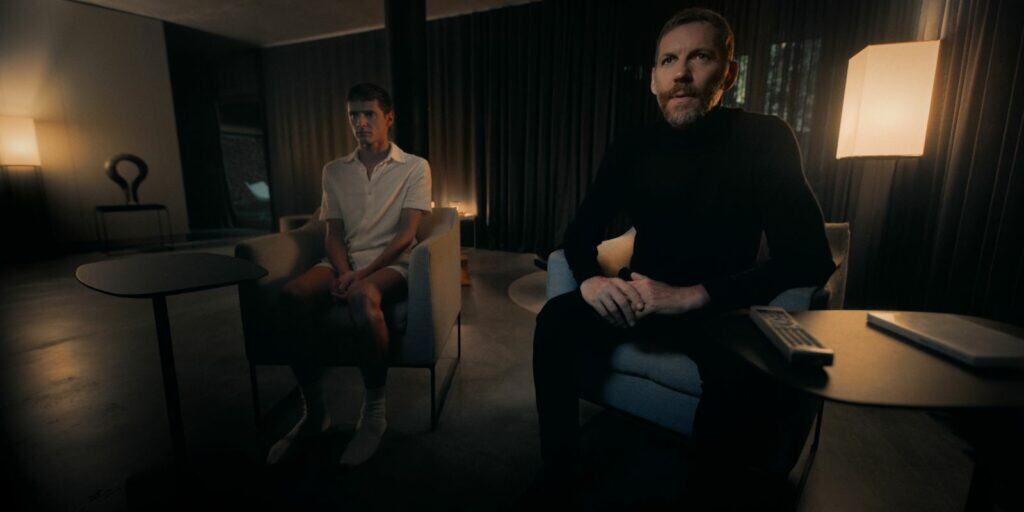
A film with flawless Interior Design 2Another Sparks album
To return to what I wrote above about Liebermann’s calculated approach to life and the world, it’s important to stress that even though Interior is an immaculately measured work, it never feels forced. During the interview, Schuh and Ackermann said that the impetus for the work came from both personal feelings and what they see in real life in Berlin, where people don’t need a Dr Liebermann to tell them not to react when someone is in trouble. With all the technical accomplishments on display in the film, it remains a profoundly human work that is bound to touch the interior heart of the spectator.
I haven’t described the film in detail because I don’t want to divulge too much about this highly impressive work. In a year with many strong first features, this one tops them all. I’ve seen several references to Haneke concerning the film. I would say that the achievement of combining cinematic precision with the human aspect is something the Austrian director could only dream about. Interior was presented in the First Feature section of the Black Nights Film Festival, where it won the Competition Audience Award.