I saw the film Everytime by Sandra Wollner (reviewed here) in the Un Certain Regard section of this year’s Cannes Film Festival. I sat down with the director to talk about the film.
The Disapproving Swede: I want to start from the beginning, and with that I mean your first film, Das unmögliche Bild. I’m thinking about the line “Memory is unreliable; sometimes what we see is the future.” You’ve been playing with these ideas for some time now. Can you talk about that? Time is nebulous in this film as well.
It makes me emotional that you recognise that. That was my first film after film school, the first one in the real world, with a solid budget, so to say. I think all my films play in a cosmos that I may recall every time, where memory and imagination are so close together that sometimes both are unreliable and interchangeable in a way. I don’t mean that in the sense of how memories in our culture are always changing. We know memory is fluid; imagination is fluid. What else is memory than imagining the past?
I think we, as human beings, are the physique and body, which is, of course, very important, but we are also ghostly beings. We are made of memories and imaginations, made of fiction. We are thrown into the world, but we aren’t just there. We constantly fictionalise it; otherwise, we wouldn’t be able to walk through this chaos. Fictionalising means giving things names, making associations, imaginings. This is something that very much interests me. It’s not that I try to go back to that topic; it just happens unconsciously. It’s the thing that interests me as a human being.
Sandra Wollner about the film’s structure
You start the film almost like a documentary.
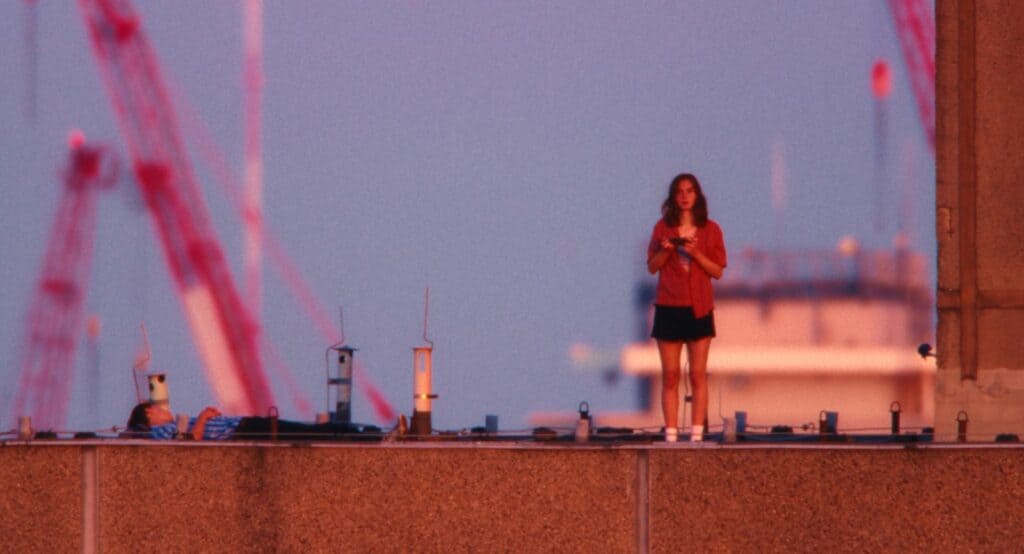
Yes, I was interested in a very down-to-earth, streetwise, everyday-life observation that had to feel concrete, authentic and trustworthy—not romanticised. I think it was so important to really ground the reality they live in, so that is what we see and trust. There is a little shift already when she falls, and also with the drone. Then you turn around the corner and end up in a strange back room where suddenly everything that lies beneath that concrete surface comes up. Something unspoken comes to the surface and folds up a new reality.
Even structurally, your script is wonderfully written. There are also these jumps, time lapses. We see an accident, and then finally this, and there’s a gap in between.
For me, some time needed to pass after the tragedy. After we see the tragedy and the computer game, we see black. I hope the audience isn’t entirely sure what they saw. Immediately after the tragedy, the mother wasn’t able to do anything. She was probably in very deep grief, but I didn’t want to show that. I felt I couldn’t, because it would have felt somewhat voyeuristic. I just personally felt it’s not a place I wanted to go.
I was more interested in what happens a year later. She’s there, and her life goes on. The sun didn’t stop; nothing changed; everything changed. But she still talks on the phone, organises things even at the graveyard, and talks with her younger daughter about what’s for dinner. I was more interested in having this as the absence, and then mirroring it with scenes that are similar but aren’t, because they’re missing a person. That was the main idea.

TDS: I want to talk about the formal aspects of the film. Was the formal side the most important from the beginning, or did you actually begin with the storyline? Are they interrelated?
I think it’s interchangeable. The characters grew, and I carried them around for quite some time. I met people in my life who led me to those characters. But initially there is always something I’m quite interested in formally. I’m always asking myself: who is actually watching, and what is happening? So I was very much interested in this shape shift.
I was writing a different story as well, during an artist residency in LA. It was called “People in the Sun.” It was set in a world where the sun just didn’t set anymore. At some point I felt maybe it was too late for that story, so that project shifted into this film. Sometimes with writing I follow a rhythm or a sentence, and suddenly I’m somewhere else. I try to keep the things that make rhythmic sense to me.
Did it take a long time to write?
It took me longer than before. I started in 2020, directly after The Trouble with Being Born came out. My Austrian producer asked if I had something to write, and since I love to work and love to write, I started immediately.
Does the tragedy of losing a child come from a personal place for you?
It comes from a few meetings I had. It’s not one specific thing. But of course, unconsciously, things feed into that. As a kid, I nearly drowned. I only remember one image from that: a fish underwater. As a teenager, I had a tragic accident after a high school party. I fell from quite a height. I only remember the fall. Those moments shaped something.
TDS: I was fascinated not only by the images but also by the sound and music of the film. Can you talk more about it?
Sound is always very important for me. My partner wrote the main theme on the piano when I told him the story. It was so beautiful it had to be in the film. It’s one theme that runs through the whole film. I was interested in the overlap of inner and outer reality. The sandbox games have this simple, naive, meditative but also uncanny music. I wanted to overlap that with Jesse’s own gaming.
TDS: You mentioned your partner 1Timm Kröger lensed Wollner’s first two films, but also directed Die Theorie von Allem. , but here you worked with Gregory Oke, who shot Aftersun. How did that come about?
It was more of a private choice. We both saw Aftersun and thought he would be perfect. It turned out that we have very similar thoughts about cinema.
We haven’t said a word about your wonderful actresses.
I feel very privileged. Birgit Minichmayr is amazing. Lotte Shirin Keiling was the first kid I saw, and I wanted her. Tristan Lopez was also fantastic. I’m very grateful they all said yes.